

This article is for you if you want to stay strong without beating up your joints!
There’s a quiet, often overlooked shift that begins for most men sometime after 50. Maybe you notice it first when climbing a flight of stairs leaves you winded, or when your favorite weekend activities make you sore for days. It’s easy to shrug these moments off as the natural march of time, but science has a name for this decline: Sarcopenia.
Sarcopenia isn’t a disease—it’s the slow, quiet erosion of strength that most men assume is inevitable. But it’s not. It’s simply what happens when muscle is no longer challenged often or intelligently enough. If ignored, sarcopenia triggers a domino effect: a slower metabolism, more body fat, insulin resistance, and a higher risk of injury. Fortunately, research—including a pivotal 2014 study in the Journal of Gerontology: Medical Sciences—shows that resistance training is one of the most effective ways to fight back.
You can read about why strength training is an essential investment here, but today we are looking at the specific style of training that yields the fastest results for the 50+ body. Because here’s the thing: not all resistance training is equal once you hit 50. If your goal is to maximize results while protecting your joints and promoting long-term health, there’s one training style that stands out above the rest: Hypertrophy training.
Understanding the Enemy: The Reality of Muscle Loss
Before we look at the solution, we have to understand what we’re up against. After age 30, most men lose about 3% to 5% of their muscle mass per decade. Once you hit 50, that rate often doubles. In plain terms: the older you get, the harder your body works to get weaker—unless you give it a reason not to.
This isn’t just a physical change; it’s a metabolic one. Muscle tissue is “expensive” for the body to keep. It requires a lot of energy (calories) just to sit there. When you lose muscle, your basal metabolic rate—the calories you burn while doing nothing—plummets. This is why many men find themselves gaining a “spare tire” even if they haven’t changed their eating habits.
Furthermore, muscle acts as a massive sink for blood sugar. The more muscle you have, the better your body handles carbohydrates. When muscle vanishes, your risk of insulin resistance and Type 2 diabetes climbs. Fighting sarcopenia isn’t about vanity; it’s about keeping your internal “engine” running efficiently.
Why Hypertrophy Beats "Heavy" or "High Rep" Training
When most guys think of weightlifting, they think of one of two extremes. Either they think of the “Glory Days” style—trying to bench press as much as humanly possible for a single, grinding rep—or they think of the “Endurance” style—using tiny weights for dozens of reps until they’re bored.
For a man over 50, both of these have major downsides.
The Heavy Trap: Lifting maximal weights (1–5 reps) is great for pure strength, but it’s brutal on the joints. As we age, our tendons and ligaments become less elastic. They don’t have the same “spring” they once did. Pushing for a one-rep max is a high-risk, low-reward game at this stage of life.
The Endurance Trap: Doing 20 or 30 reps with light weights might make you sweat, but it rarely provides enough “mechanical tension” to signal the body to grow. In your 50s, your body is looking for any excuse to shed muscle to save energy. You have to give it a very loud reason to keep it.
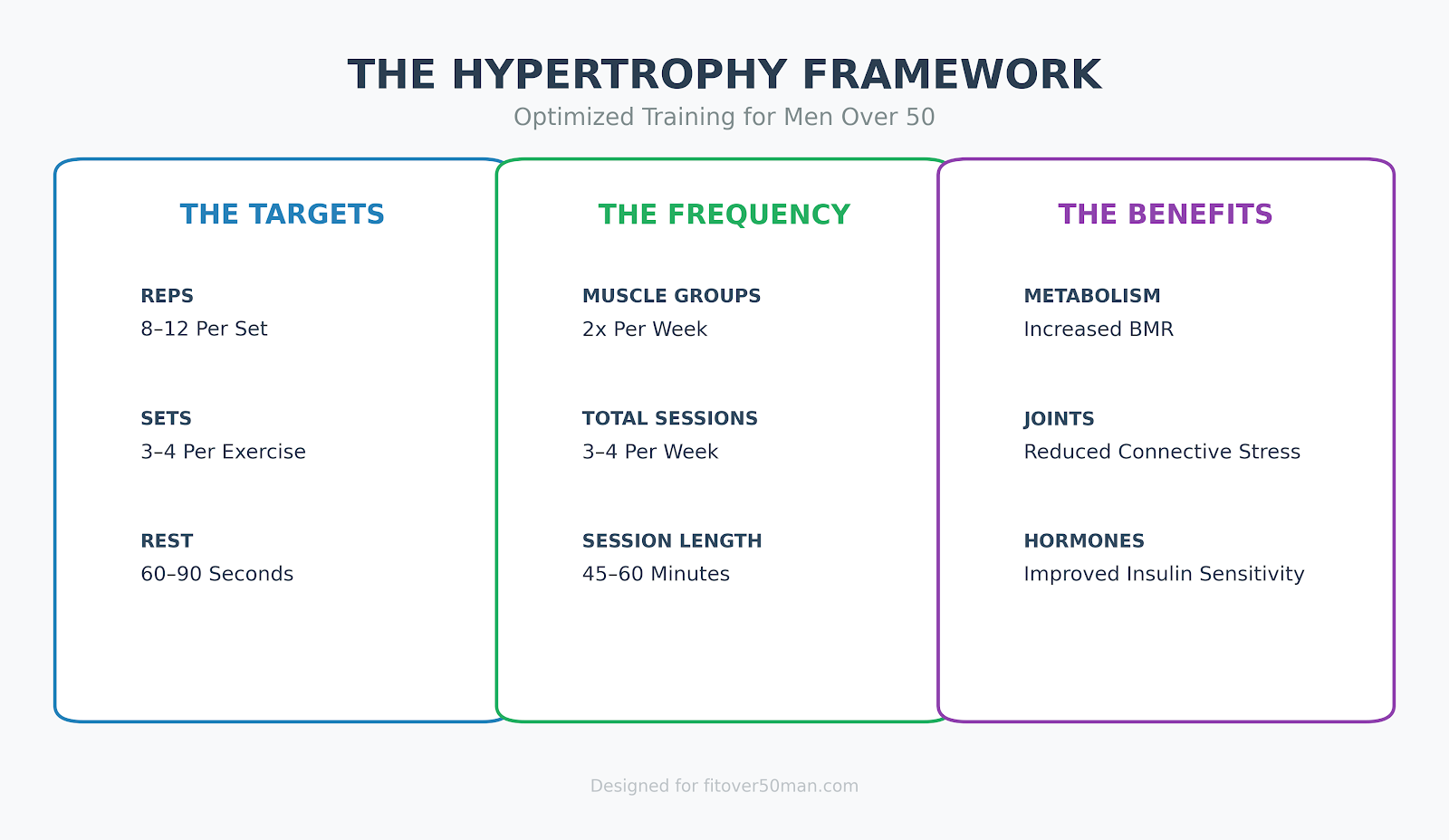
The Smarter Middle Ground – Hypertrophy Solution: By working in the 8–12 rep range, you use weights that are heavy enough to challenge the muscle fibers but light enough that you can maintain perfect control. This provides the ideal balance of “mechanical tension” and “metabolic stress”—the two primary drivers of muscle growth.
The Science of "Anabolic Resistance"
There’s a concept in sports science called Anabolic Resistance. It’s the idea that as we get older, our muscles become “stubborn.” In your 20s, a protein shake and a decent workout were enough to spark growth. At 50, the “on switch” for muscle building—a pathway called mTOR—requires a much more deliberate stimulus.
Hypertrophy training works because it forces the switch to stay on longer. By using moderate weights and controlled movements, you create micro-trauma in the muscle fibers. When you recover, your body repairs those fibers slightly thicker and stronger than before. This is the only way to counteract the natural “downsizing” that aging tries to force on us.
Building the Routine: Exercise Selection for Longevity
The exercises you choose can make or break your progress. At this stage, we want to prioritize “Compound Movements”—exercises that work multiple muscle groups at once. They are more efficient and translate better to real-world strength.
1. The Goblet Squat (Legs & Hips)
Forget the heavy barbell on your back. Hold a dumbbell or kettlebell against your chest. This naturally forces you to stay upright, taking the pressure off your lower back while torching your quads and glutes. Strong legs are the number one predictor of physical independence as we age.
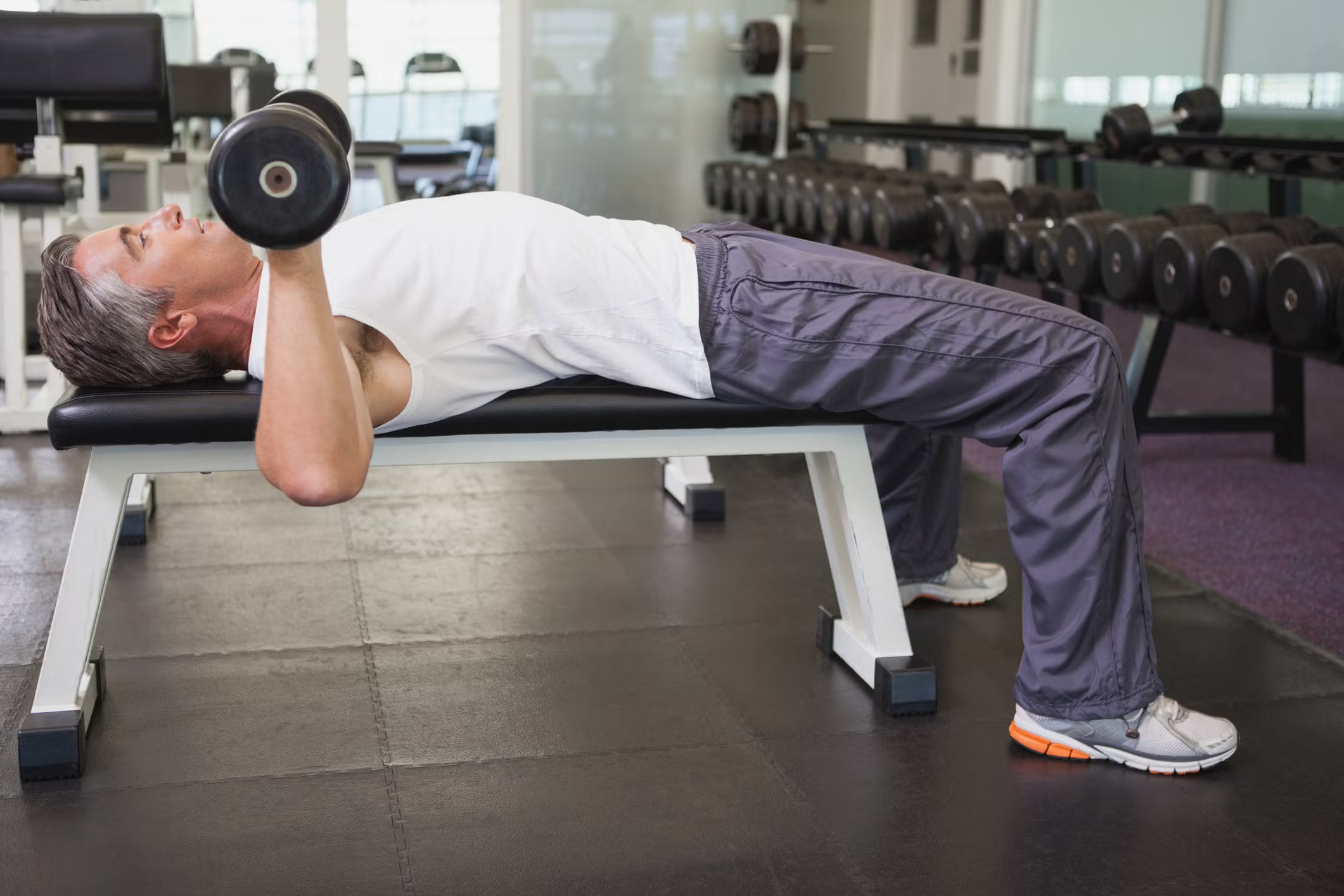
2. The Dumbbell Bench Press (Chest & Shoulders)
Forget the heavy barbell on your back. Hold a dumbbell or kettlebell against your chest. This naturally forces you to stay upright, taking the pressure off your lower back while torching your quads and glutes. Strong legs are the number one predictor of physical independence as we age.
3. The One-Arm Row (Back & Posture)
One of the hallmarks of aging is the “forward slump.” Rows counteract this by strengthening the muscles between your shoulder blades. Doing them one arm at a time allows you to focus on the “squeeze” and ensures your core is working to stabilize your body.
4. The Romanian Deadlift (Hamstrings & Lower Back)
This isn’t about pulling 400 lbs off the floor. It’s a controlled “hinge.” By lowering weights to just below your knees while keeping a flat back, you strengthen the hamstrings and glutes. This is the secret to a bulletproof lower back.
The Mind-Muscle Connection: Quality Over Ego
The most important thing to bring to the gym isn’t a pre-workout drink; it’s intent.
In your 20s, you could just “heave” weight around and see results. At 50, you need to feel every inch of the movement. This is called the Mind-Muscle Connection. When you’re doing a bicep curl, don’t just swing the weight. Focus on the muscle contracting. Slow down the “lowering” phase (the eccentric).
Research shows that the lowering phase of an exercise is actually where the most muscle growth is triggered. If you drop the weight quickly, you’re missing out on 50% of the benefit. Control the weight; don’t let the weight control you.
Nutrition: The Fuel for the Rebuild
You can’t build a house without bricks. In the world of hypertrophy, those bricks are Protein.
Because of anabolic resistance, you actually need more protein than a younger man to get the same result. A good rule of thumb is to aim for 0.8g to 1g of protein per pound of body weight. If you weigh 200 lbs, that’s 160g–200g of protein spread throughout the day.
The Leucine Trigger:
Focus on high-quality protein sources like eggs, lean beef, chicken, and whey. These are high in an amino acid called Leucine, which acts as the “key” that unlocks the muscle-building process.
Don't Forget the Micronutrients:
- Magnesium: Great for muscle relaxation and sleep.
- Vitamin D: Essential for bone health and natural testosterone support.
- Creatine: One of the most researched supplements in the world. It’s safe, effective, and specifically helps older adults maintain muscle mass and cognitive function.
The Role of Recovery: When Growth Actually Happens
Here is a hard truth: you don’t grow muscle in the gym. You grow muscle while you’re asleep.
The gym is where you provide the stimulus. The recovery period is where the repair happens. As we age, our recovery window gets longer. This is why we don’t recommend training the same muscle every single day.
The 72-Hour Rule: Give a muscle group at least 48 to 72 hours of rest before hitting it again. This is why a 3-day full-body split or a 4-day upper/lower split is so effective. It gives you maximum growth signal with maximum recovery time.
Sleep is Non-Negotiable: If you’re only getting five hours of sleep, your body is in a “stress state.” It will prioritize storing fat and breaking down muscle. Aim for 7–8 hours to keep your hormones balanced and your recovery on track.
Common Myths and Mistakes
Myth: “Lifting weights will make my joints hurt worse.”
Truth: Done correctly, hypertrophy training actually reduces joint pain. By strengthening the muscles around the joints (like the quads for the knees), you take the pressure off the connective tissue and the bone.
Myth: “I’ll get ‘too big’ or ‘bulky’.”
Truth: It takes a Herculean effort to get “too big” at 50. What will actually happen is you’ll look firmer, your clothes will fit better, and you’ll lose that “soft” look that comes with muscle loss.
Mistake: Training Through “Bad” Pain
There is a difference between the “burn” of a hard set and the “sharpness” of an injury. If a movement feels sharp or “wrong,” stop. In your 50s, a six-month injury is a massive setback. Always choose form over weight.
The Training Table: A Sample Week
This is a simple, effective 3-day routine designed for maximum muscle retention and growth.
Exercise | Primary Target | Sets | Reps | Rest |
Goblet Squat | Legs/Glutes | 3 | 10–12 | 90s |
DB Bench Press | Chest/Shoulders | 3 | 8–10 | 90s |
One-Arm DB Row | Back/Lats | 3 | 10–12 | 60s |
Romanian Deadlift | Hamstrings/Back | 3 | 10–12 | 90s |
Lateral Raises | Shoulders | 2 | 12–15 | 60s |
Tricep Pushdown | Triceps | 2 | 12–15 | 60s |
DB Bicep Curl | Biceps | 2 | 12–15 | 60s |
| Exercise | Primary Target | Sets | Reps | Rest |
|---|---|---|---|---|
| Goblet Squat | Legs / Glutes | 3 | 10–12 | 90s |
| DB Bench Press | Chest / Shoulders | 3 | 8–10 | 90s |
| One-Arm DB Row | Back / Lats | 3 | 10–12 | 60s |
| Romanian Deadlift | Hamstrings / Back | 3 | 10–12 | 90s |
| Lateral Raises | Shoulders | 2 | 12–15 | 60s |
| Tricep Pushdown | Triceps | 2 | 12–15 | 60s |
| DB Bicep Curl | Biceps | 2 | 12–15 | 60s |
Reclaiming Strength on Your Terms
The “march of time” doesn’t have to be a slow decline into frailty. While we can’t stop getting older, we can absolutely decide how we age. Sarcopenia is a formidable opponent, but it is one that can be managed, fought, and often defeated.
By choosing hypertrophy training, you aren’t just “working out.” You are investing in your future self. You are choosing to be the man who can still hike the trails, play with his grandkids, and move through the world with strength and confidence.
It’s not about how much you can lift compared to the guy next to you; it’s about how much better you feel compared to the version of you that was sitting on the couch.
If you’re ready to start training with intention, I can help. I create custom hypertrophy programs designed specifically for men over 50—taking into account your goals, your history, and your schedule.