

You’ve dialed in your macros. You’re hitting the squat rack three times a week. You’ve even swapped your afternoon muffin for a protein shake. But despite the effort, the scale isn’t moving quite right, your joints feel “creaky,” and that mid-afternoon brain fog is hitting harder than it used to.
If this sounds familiar, you’re likely overlooking the most potent performance-enhancing “supplement” available to the modern man: Sleep.
For a man over 50, sleep isn’t just a period of inactivity. It is an active, aggressive state of biological repair. In fact, if you aren’t sleeping properly, you aren’t just slowing down your progress—you are actively sabotaging your hormonal health, your muscle protein synthesis, and your long-term cognitive edge.
Here we’re going to break down the science behind recovery, how your brain clears out metabolic waste while you sleep, and a practical plan to improve your rest so you can actually see the results of your hard work.
Why You Don't Actually Grow in the Gym
There is a common misconception among men who grew up with the “no pain, no gain” mantras of the 80s and 90s: the idea that muscle is built during the workout. This is physiologically backward.
When you train—whether it’s heavy deadlifts, a sprint session, or a grueling rucking circuit—you are performing a catabolic activity. You are creating micro-tears in your muscle fibers, depleting glycogen stores, and placing a massive amount of stress on your central nervous system (CNS).
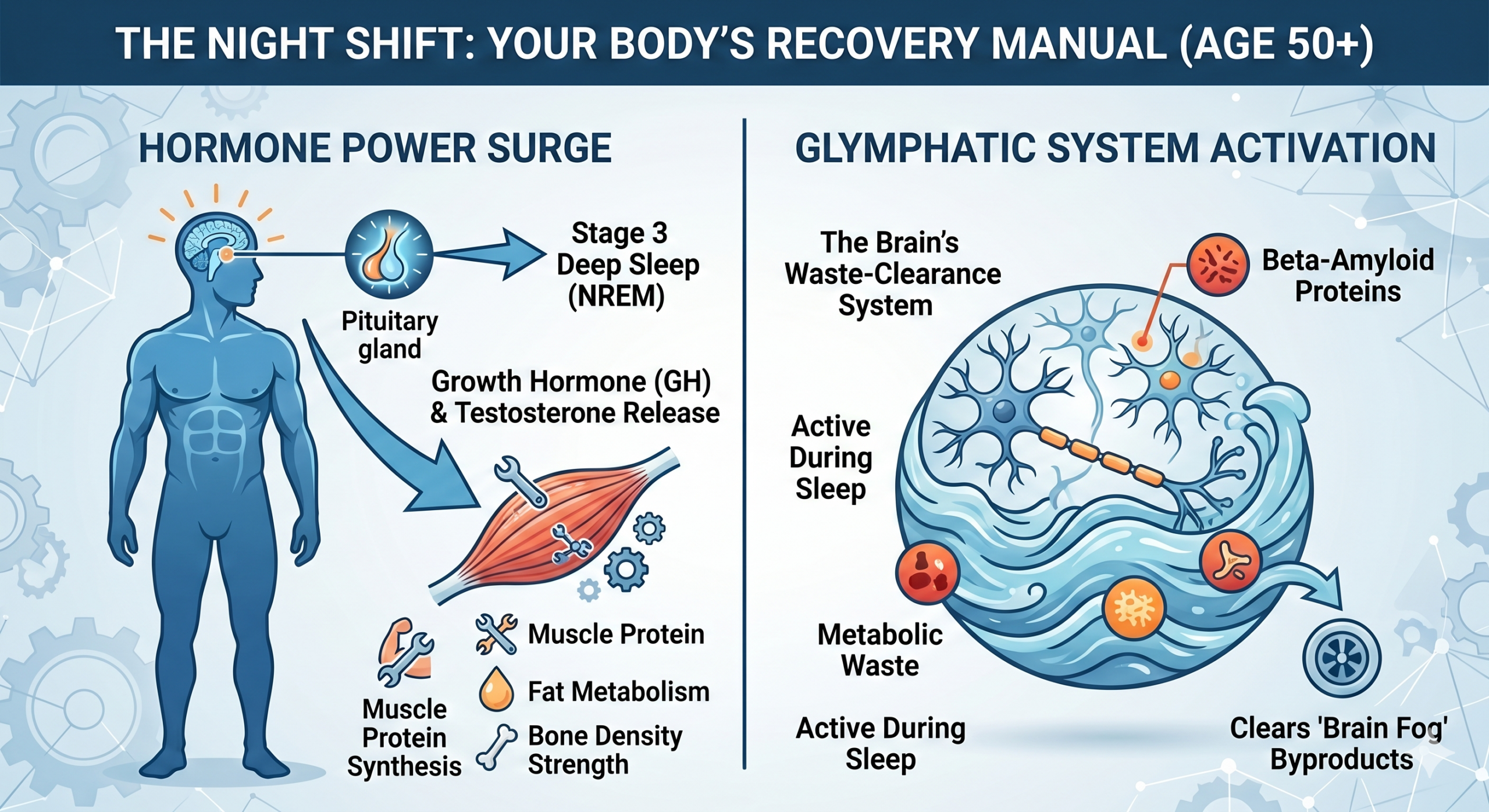
The anabolic (building) phase only happens during recovery. And the absolute peak of that recovery occurs while you are in Stage 3 Non-Rapid Eye Movement (NREM) sleep.
The Hormonal Fountain of Youth: GH and Testosterone
For older men, hormones are the primary lever for body composition. As we age, our natural production of Growth Hormone (GH) and Testosterone begins a steady decline. Sleep is the master regulator of these levels.
- Growth Hormone (GH): About 70% of your daily GH pulse occurs during deep sleep. This hormone is the “master repairman.” It stimulates protein synthesis, helps metabolize fat, and strengthens bone density. If you cut your sleep from 8 hours to 5, you aren’t just tired; you are firing your best worker right when the project needs him most.
- Testosterone: Most testosterone release happens during sleep. Research in the Journal of the American Medical Association (JAMA) found that just one week of sleep deprivation (5 hours per night) decreased testosterone levels in healthy young men by 10–15%. For a man over 50, whose levels are already naturally lower, this drop can be devastating, leading to muscle loss, increased irritability, and lower libido.
The Cortisol Trap
When you lack sleep, your body perceives a state of emergency. In response, it spikes cortisol, the primary stress hormone. While cortisol is necessary for waking up in the morning, chronically high levels are “muscle-eating.”
High cortisol inhibits the uptake of amino acids into the muscles and encourages the body to store visceral fat—that stubborn, dangerous belly fat that wraps around your organs. For the busy professional, high cortisol combined with low sleep is a fast track to “skinny-fat” syndrome and chronic burnout.
The Glymphatic System: "Washing" Your Brain
Your brain is your most valuable asset, and it requires a specific type of daily maintenance to function at its peak. You wouldn’t show up to an important meeting with a laptop battery at 10%, yet many men show up with a half-recovered brain.
Recent neuroscience has discovered the Glymphatic System. Think of it as your brain’s waste-clearance system. During the day, your brain’s intense metabolic activity creates “trash”—specifically metabolic byproducts like beta-amyloid proteins (linked to Alzheimer’s).
When you sleep, your brain cells actually shrink slightly, increasing the space between them. This allows cerebrospinal fluid to wash through and “flush” the metabolic waste away. This system is ten times more active during sleep than during wakefulness.
If you aren’t getting enough deep sleep, this “trash” builds up. This is the biological reason behind “brain fog,” poor word recall, and the inability to make complex decisions. For men over 50, supporting the glymphatic system is a critical strategy for long-term cognitive health and avoiding age-related decline.
Joint Health and Systemic Inflammation
One of the biggest hurdles for men over 50 starting a fitness program is joint pain. “My knees can’t handle the squats,” or “My shoulders are shot.”
While form and load management are critical, sleep plays a massive role in systemic inflammation. During sleep, your body produces cytokines—proteins that help the immune system communicate and fight off inflammation.
When sleep is restricted, your body’s ability to regulate these inflammatory markers is compromised. This leads to:
- Increased sensitivity to pain (lower pain threshold).
- Slower healing of connective tissues (tendons and ligaments).
- Chronic “creakiness” that prevents you from training with the intensity required for results.
If you want to keep lifting into your 60s and 70s, you must view sleep as your primary “joint supplement.”
The Architecture of Sleep: Quality vs. Quantity
Not all hours in bed are created equal. To optimize recovery, we need to understand the four stages of sleep. A full cycle takes about 90 minutes, and a healthy man needs about 5 to 6 of these cycles per night.
1. Light Sleep (Stages 1 & 2)
This is the transition phase. Your heart rate slows, and your body temperature drops. While you spend about 50% of your night here, this isn’t where the heavy lifting of physical recovery happens.
2. Deep Sleep / Slow Wave Sleep (Stage 3)
This is the “Physical Recovery” stage. This is when the GH surge happens, tissues are repaired, and the immune system is bolstered. For men over 50, this is the most important stage for muscle retention. As we age, the percentage of time we spend in deep sleep naturally decreases, making it even more vital to optimize our environment to stay in this stage as long as possible.
3. REM Sleep (Rapid Eye Movement)
This is the “Mental Recovery” stage. This is where dreaming occurs, and your brain consolidates memories and processes emotions. REM is crucial for learning new motor skills—like the complex mechanics of a proper deadlift or a golf swing.
Tangible Tips: The Professional’s Sleep Protocol
If you are a busy professional, you probably pride yourself on your systems and processes at work. It’s time to apply that same systems-thinking to your bedroom.
1. The 3-2-1 Rule for Evening Transitions
You wouldn’t jump into a 300lb squat without a warmup. Your brain needs a “cooldown” from a high-stress workday.
- 3 Hours Before Bed: Stop eating large meals. Digestion raises core body temperature, which can prevent you from entering deep sleep.
- 2 Hours Before Bed: Stop working. Close the laptop. The mental “open loops” of unsolved work problems keep your brain in a state of high-beta wave activity.
- 1 Hour Before Bed: No screens. The blue light from your phone mimics sunlight, suppressing melatonin and tricking your brain into thinking it’s noon.
2. Master Your "Sleep Cave" Geometry
Your environment should be optimized for a single purpose: unconsciousness.
- Temperature: Aim for 65–68°F (18–20°C). Your body needs to drop its core temperature by about 2–3 degrees to initiate sleep. If the room is too warm, you will stay in light sleep.
- Darkness: Total blackout. Use blackout curtains or a high-quality eye mask. Even the tiny LED light from a power strip can disrupt the pineal gland’s production of melatonin.
- Sound: If you live in Calgary or any busy urban area, unpredictable noises (sirens, neighbors) can “micro-wake” you, pulling you out of deep sleep even if you don’t remember it. Use a white noise machine or a fan.
3. Caffeine and the Adenosine Blockade
Caffeine works by blocking adenosine, the chemical that builds up in your brain throughout the day to make you feel “sleep pressure.” Caffeine has a half-life of about 5–6 hours. This means if you have a “pick-me-up” coffee at 4:00 p.m., half of that caffeine is still buzzing in your brain at 10:00 p.m. The Rule: Cut off all caffeine by 2:00 p.m. If you need energy in the afternoon, try a 10-minute walk or cold water—don’t reach for the bean.
4. The Alcohol Myth
Many men use a glass of scotch or wine to “unwind” and fall asleep. While alcohol is a sedative that helps you fall asleep faster, it is a metabolic toxin that destroys sleep quality. Alcohol fragments your sleep and almost entirely eliminates REM cycles. You might be “unconscious” for 8 hours, but you will wake up chemically unrecovered. If you do drink, try to finish at least 3 hours before your head hits the pillow.
Nutritional Support for Overnight Recovery
What you put in your body before bed can act as a catalyst for muscle repair.
Casein Protein: The Slow Drip
Unlike whey protein, which is rapidly absorbed, Casein (found in Greek yogurt, cottage cheese, or casein supplements) clots in the stomach and digests slowly over 6–8 hours. A study in Medicine & Science in Sports & Exercise showed that consuming 40g of casein protein before bed significantly increased muscle protein synthesis rates overnight in older men. It provides a steady “slow drip” of amino acids, preventing the catabolic state that can occur during a long fast.
Magnesium: The Relaxation Mineral
Most men are deficient in magnesium. It plays a role in over 300 enzymatic reactions, including those that regulate the nervous system. Taking a high-quality Magnesium Glycinate supplement 30 minutes before bed can help relax muscles and reduce the “restless leg” feeling that keeps many men awake.
The Role of Hydration
Dehydration can lead to nighttime leg cramps and snoring (due to dry airways). However, you want to avoid “front-loading” your water in the evening, which leads to multiple bathroom trips (nocturia). The Fix: Hydrate aggressively in the morning and afternoon, then sip only small amounts of water after 7:00 p.m.
The Strategic Importance of Napping
If you’ve had a poor night’s sleep due to a late-night flight or a family emergency, a strategic nap can save your training session.
- The “Power Nap” (20 Minutes): Perfect for a boost in alertness and motor performance without the “nap hangover” (sleep inertia).
- The “Full Cycle” (90 Minutes): If you are seriously sleep-deprived, a 90-minute nap allows for a full cycle of NREM and REM sleep. Caution: Avoid napping after 3:00 p.m., as this will decrease your “sleep pressure” for the night, making it harder to fall asleep at your scheduled time.
Managing Stress: The Silent Sleep Killer
In your 50’s, the weight of responsibility—career, aging parents, college tuition for kids—is often at its peak. This mental load creates a “tired but wired” state.
If you lie in bed thinking about your to-do list, your brain is trying to act as a storage device rather than a processor. The Action: Keep a notepad by your bed. Before lying down, write out the 3 most important things you need to do tomorrow. Once it’s on paper, your brain feels “permitted” to let go of the thought.
Box Breathing
This is a technique used by Navy SEALs to down-regulate the sympathetic nervous system (fight or flight) and activate the parasympathetic nervous system (rest and digest).
- Inhale for 4 seconds.
- Hold for 4 seconds.
- Exhale for 4 seconds.
- Hold for 4 seconds. Repeat this for 5 minutes. It is physically impossible for your body to remain in a high-stress state while performing controlled, rhythmic breathing.
Your 7-Day Sleep Excellence Action Plan
Don’t try to change everything tonight. High-performance habits are built through incremental wins.
- Day 1–2: The Baseline. Don’t change your habits. Just use a tracker (Oura, Whoop, or even a simple journal) to see when you actually fall asleep and how you feel the next morning on a scale of 1–10.
- Day 3–4: The Caffeine & Light Shift. Implement the 2:00 p.m. caffeine cutoff and the 1-hour screen-free rule. Notice the difference in how quickly your mind “quiets” when your head hits the pillow.
- Day 5–6: The Environment Audit. Buy the blackout curtains. Set your thermostat to 67°F. Clear the clutter out of your bedroom. Make it a sanctuary.
- Day 7: The Recovery Review. Look back at your training logs from the week. Did you have more “pop” in your lifts? Was your focus sharper during your afternoon meetings?
The Bottom Line
For the man over 50, fitness is no longer a game of “who can suffer the most.” It is a game of optimization. You cannot “hustle” your way past your biology.
Prioritizing sleep is not “taking it easy.” It is the single most effective way to:
- Accelerate Muscle Growth: By maximizing your natural Growth Hormone pulses.
- Protect Your Brain: By allowing the glymphatic system to clear out metabolic waste.
- Stay Injury-Free: By regulating systemic inflammation and repairing connective tissue.
- Master Your Body Composition: By keeping cortisol low and insulin sensitivity high.
If you are serious about your results, stop treating sleep as an afterthought. Treat it as the foundation of your entire program.
Are you struggling with poor sleep, slow recovery, or feeling like you’re working hard in the gym but seeing no results? Most are over-training and under-recovering. We specialize in building custom high-performance protocols that integrate training, nutrition, and recovery into your lifestyle. Stop guessing and start progressing.