


There is a common misconception that if you aren’t leaving the gym absolutely exhausted, you haven’t worked hard enough. For decades, the “No Pain, No Gain” mantra has been the default setting for anyone looking to build muscle. But as we cross the 50-year mark, that philosophy becomes a liability.
The reality is that your body’s ability to recover from high-intensity “grinder” sets isn’t what it used to be. Your joints, tendons, and central nervous system (CNS) require a more calculated approach to avoid the cycle of injury and burnout. This is where RIR (Reps In Reserve) comes in.
RIR is a systematic way to measure your intensity. It allows you to stimulate muscle growth and strength without redlining your engine every single workout. Let’s break down exactly how to use this “Executive Strategy” for your fitness to ensure you’re gaining muscle, protecting your joints, and staying consistent for the long haul.
What Exactly is RIR?
RIR stands for Reps In Reserve. It is a subjective measure of intensity that tells you how many more “good” repetitions you could have performed at the end of a set before your form broke down or you reached total muscular failure.
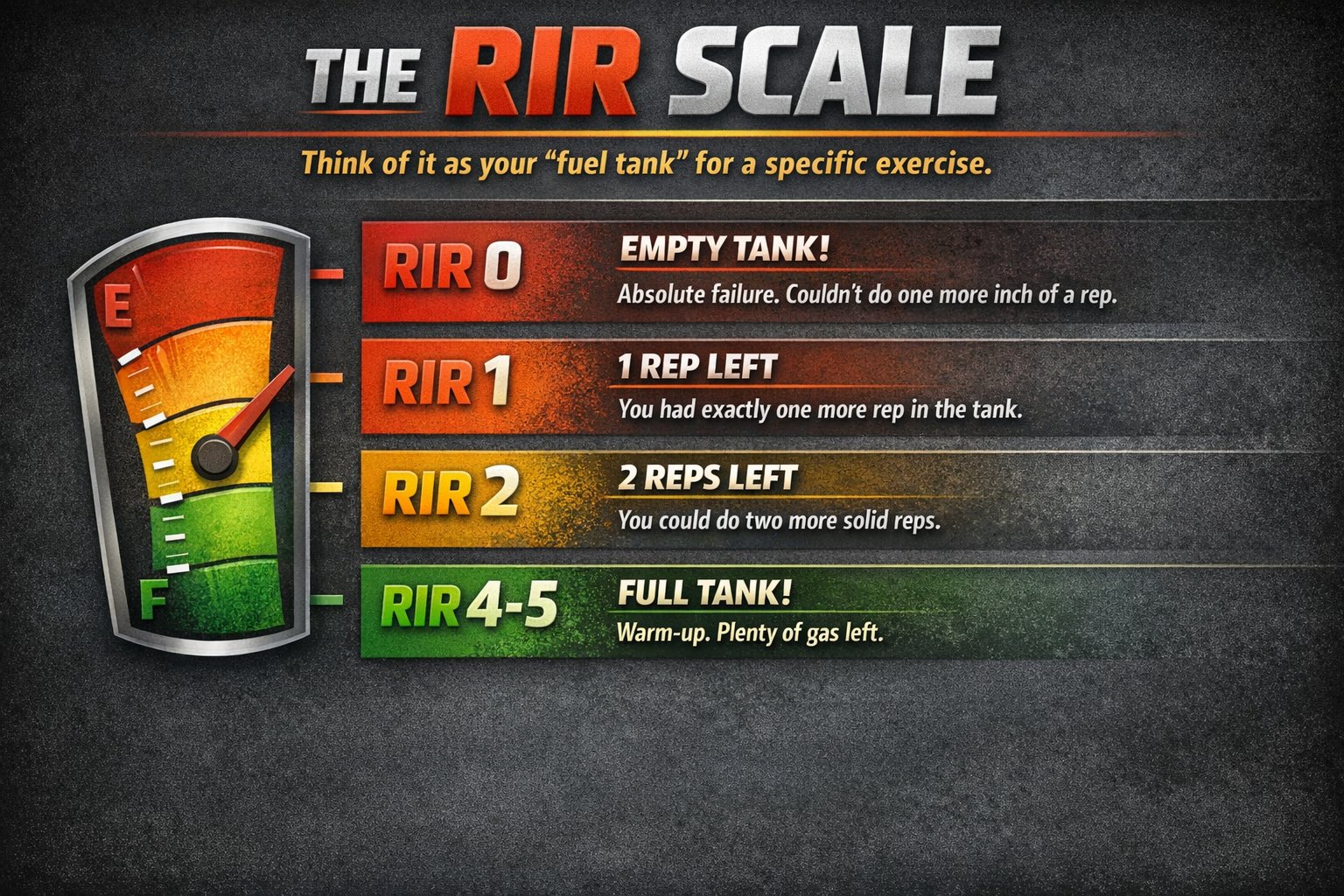
Think of it as your “fuel tank” for a specific exercise.
- RIR 0: You reached absolute failure. You could not have done one more inch of a rep even if your life depended on it.
- RIR 1: You finished the set knowing you had exactly one more rep left in the tank.
- RIR 2: You felt the burn, but you could have done two more solid reps with perfect form.
- RIR 4-5: This is essentially a warm-up. You have plenty of gas left.
The Biological Shift: Why Failure is a Young Man’s Game
In your 20s, your body is a recovery machine. You can eat a pizza, sleep four hours, train to failure on every set, and wake up feeling like a million bucks.
In your 50s, the physiology changes. We face sarcopenia (age-related muscle loss) and a decrease in collagen synthesis, which makes our tendons and ligaments less “springy.” When you push a set to absolute 0 RIR, you aren’t just taxing the muscle; you are redlining your nervous system and putting massive shear force on your joints.
For a man over 50, the goal is Sustainability. If you train so hard on Monday that you can’t walk until Thursday, you’ve lost three days of potential movement. RIR allows you to “live to fight another day” while still providing the signal your body needs to grow.
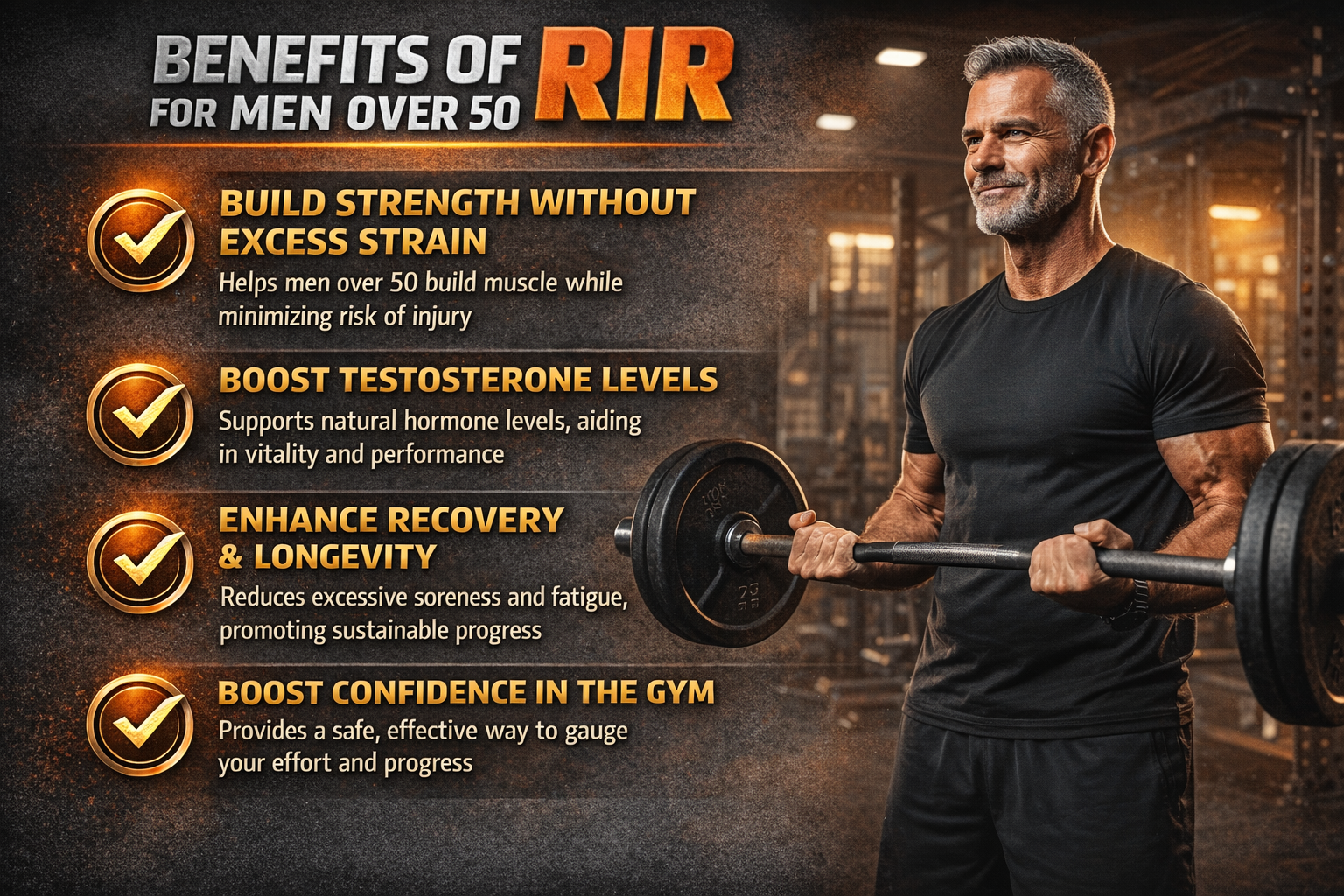
Joint Protection
Avoids the "grinding" reps that cause tendonitis.
Better Recovery
Leaves you with energy for your career and family.
Sustainable Progress
Consistent gains without injury-induced layoffs.
The Science of "Stopping Early"
You might be thinking, “If I’m not pushing to failure, am I even building muscle?”
The answer is a resounding yes. Research by Helms et al. (Journal of Strength and Conditioning Research, 2016) demonstrated that RIR-based training is highly effective for both muscle growth (hypertrophy) and strength. The study found that as long as you are within the 1 to 3 RIR range, you are stimulating almost the same amount of muscle growth as you would by going to total failure—but with significantly less fatigue.
When you go to failure (RIR 0), the “fatigue cost” increases exponentially, but the “growth benefit” only increases marginally. For a busy professional, that’s a bad ROI (Return on Investment). RIR 2 is the “Goldilocks Zone”—hard enough to change your body, but smart enough to keep you healthy.
RIR vs. RPE: What’s the Difference?
If you’ve been reading fitness blogs, you’ve likely come across RPE (Rate of Perceived Exertion). While they are cousins, they aren’t twins.
RPE usually uses a 1–10 scale. RPE 10 is max effort, while RPE 7 is moderate. The problem with RPE for men over 50 is that it’s often too vague. “How hard was that on a scale of 1 to 10?” is a question that invites a lot of guesswork.
RIR is more concrete. Instead of asking how you feel, RIR asks how many reps you have left.
- An RPE 8 roughly equals an RIR 2.
- An RPE 10 equals an RIR 0.
For most guys, counting reps left in the tank is much more intuitive than assigning an abstract “difficulty” number. When you’re under a heavy squat bar, you don’t want to do math; you want to know if you have one more clean rep in you.
The Mindset Shift: The Strategy of Strength
The single biggest reason men in their 50s quit the gym is the “all or nothing” mentality. They go in, smash themselves for three weeks, get a shoulder impingement or a lower back tweak, and then take six months off to recover.
RIR is the “Executive Strategy” for the gym. In your career, you don’t spend every single dollar of your company’s budget every Monday morning. You keep a reserve. You manage cash flow. You prepare for the unexpected. RIR is simply applying those same high-level management principles to your muscle tissue.
Leaving 1 or 2 reps in the tank isn’t “quitting.” It’s a tactical decision to ensure you can train again in 48 hours. The man who trains at RIR 2 for 52 weeks a year will always beat the man who trains at RIR 0 for three weeks and then spends the rest of the year on the couch.
Exercise-Specific RIR Guide
Not all exercises are created equal when it comes to RIR. You can push a bicep curl much closer to failure than you should push a barbell back squat. Here’s a breakdown of how to “budget” your reps depending on the movement.
Compound Lifts (Squats, Deadlifts, Overhead Press)
Target: RIR 2–4
These are high-risk, high-reward movements. Because they involve the spine and multiple joints, “form breakdown” usually happens before “muscular failure.” If you feel your lower back rounding on a deadlift, you’ve already hit RIR -1. Stop while your form is still “textbook.”
Machine Work (Leg Press, Lat Pulldowns, Chest Press)
Target: RIR 1–2
Since the machine stabilizes the weight for you, you can safely push a bit closer to the edge. You won’t drop a leg press on your chest like you might a barbell, so hitting RIR 1 is a great way to drive hypertrophy without much risk.
Isolation/Accessory Work (Curls, Tricep Pushdowns, Lateral Raises)
Target: RIR 0–1
These smaller muscles recover quickly and don’t tax the nervous system nearly as much. On the final set of your curls, it is perfectly fine to push until you simply cannot lift the weight again. Just don’t do it on every single set.
The "Fit Over 50" Beginner RIR Workout
| Exercise | Sets | Reps | Target | Focus |
|---|---|---|---|---|
| Goblet Squat / Leg Press | 3 | 8–10 | RIR 2 | Builds foundational leg strength without spinal loading. |
| Dumbbell Bench Press | 3 | 8–10 | RIR 1–2 | Safer on the shoulders than a barbell; builds chest/triceps. |
| Seated Cable Row | 3 | 10–12 | RIR 2 | Essential for posture and counteracting “desk lean.” |
| Overhead DB Press | 2 | 10 | RIR 2–3 | Builds capped shoulders; stopping at RIR 2 protects the rotator cuff. |
| Plank Hold | 3 | Hold | RIR ~1 | Stop 1 “rep” before your hips sag or your form breaks. |
Case Study: From Burnout to Consistency
Let’s look at a client of mine, “Mark” (54, VP of Sales). Mark was a former college athlete who tried to train like he was still 21. Every workout was a “max out” session.
- The Problem: Mark was perpetually dealing with “golfer’s elbow” and knee pain. He’d train hard for a month, then get “busy” (read: injured and discouraged) for two months.
- The Shift: We switched him to a strictly RIR-based program. We capped every set at RIR 2.
- The Result: For the first time in a decade, Mark trained for six months straight without a single missed session. Because he wasn’t constantly in “recovery debt,” his energy levels at the office spiked. By stopping before failure, he actually got stronger because his total weekly volume went up.
He didn’t need more “grit.” He needed a better system.
RIR and Auto-Regulation: Training for Your Reality
One of the biggest benefits for busy professionals is that RIR accounts for external stress. As a coach, I know that your “strength” isn’t a static number. If you had a 14-hour workday, three cups of coffee, and four hours of sleep, your body is physically incapable of hitting the same numbers it hits on a relaxing Sunday.
If you follow a program that says “Bench 185 lbs for 10,” and you’re having a terrible, high-stress day, you might hurt yourself trying to force that number.
With RIR, the weight adapts to you. If 185 lbs feels like RIR 0 today because you’re exhausted, you drop the weight to 165 lbs to hit your RIR 2 target. You still get a great workout, you still stimulate muscle, and you don’t blow out a pectoral muscle. This is called Auto-regulation, and it’s the secret to training for the long haul.
Frequently Asked Questions (FAQ)
Is RIR 0 ever okay for men over 50?
Yes, but sparingly. It’s best reserved for isolation exercises (like bicep curls) on the very last set of the day. Avoid RIR 0 on heavy compound movements like squats or deadlifts.
How do I know if I’m actually at RIR 2?
Look for “bar speed.” When the weight starts to move noticeably slower despite you pushing with the same intent, you are likely at RIR 2 or 3. If the rep “grinds” to a halt, you’ve hit RIR 0.
Can I use RIR for cardio?
RIR is specifically for resistance training. For cardio, you are better off using heart rate zones or the “Talk Test” (if you can’t speak a full sentence, you’re at a high intensity).
What if I can't feel my muscles working at RIR 2?
This usually means you need to slow down the eccentric (lowering) phase of the lift. Focus on a 2–3 second lowering phase. This will increase the “mind-muscle connection” without needing to go to failure.
Does RIR work for bodyweight exercises?
Absolutely. If you’re doing pushups and you feel like you could do 12 but you stop at 10, that’s RIR 2. The principle remains the same regardless of the equipment.
The Path Forward: Build a Body That Lasts
Lasting results come from strategy, systems, and long-term planning. Your fitness should be no different. Using RIR allows you to:
- Stay Consistent: You won’t be sidelined by nagging injuries.
- Recover Faster: You’ll have the energy to stay active throughout the week.
- Build Muscle: You are still providing the necessary stimulus for growth, just without the “trash fatigue.”
The goal of the Fit Over 50 Man is to be the strongest, most capable version of yourself well into your 60s, 70s, and beyond. RIR is the tool that makes that longevity possible.
Ready to Train Smarter, Not Just Harder?
Transitioning to an RIR-based program can be tricky if you’ve spent years training the “old school” way. If you want a customized program designed specifically for your body, your current fitness level, and your demanding professional schedule, I’m here to help.
Stop guessing and start following a system that works with your biology, not against it.
Fill out this form to book your 1-on-1 consultation today.
Let’s build a body that lasts.